
Special Days Every Month
Celebrate and learn about special days
every day of the year!
|
Old Christmas Day and the Lost 11 Days
|
|
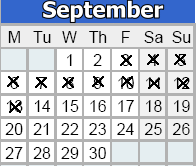
The Gregorian calendar is the one most used nowadays. It is named after Pope Gregory Xlll who introduced it in 1582. There is a leap year every four years (or more precisely, 97 leap years every 400 years). This means that the year corresponds closely with the astronomical year (365.24219 days) so that it is just one day out every 3,300 years. The Julian Calendar Up until 1753, the calendar we used in Britain was the Julian Calendar. It was based on the solar year, the time it takes for the Earth to rotate around the Sun, and thus was less accurate than the Gregorian Calendar. The Julian Calendar was 365.25 days long, which was fractionally too long, and the calendar over time fell out of line with the seasons. All change – "Give us back our 11 days!" In 1752 Britain decided to correct this by abandoning the Julian calendar in favour of the Gregorian. By doing so, 3 September instantly became 14 September – and as a result, nothing whatsoever happened in British history between 3 and 13 September 1752. Many people thought that the government had stolen eleven days of their lives. They protested in the streets, demanding "Give us back our 11 days!" All change for Christmas! Before the calendar was changed, England celebrated Christmas on the equivalent of the 6th of January by our modern, Gregorian reckoning. That is why in some people still call the 6th January, Old Christmas Day. 6 January is also known as Epiphany or Twelfth Day Link Calendar Patterns – Maths investigation Also on this day … 6 January 1066: The coronation of Harold II, as King of England, succeeding Edward the Confessor. He reigned for ten months before he died at the Battle of Hastings. 6 January 1540: Henry VIII married Anne of Cleves at Greenwich Palace, London. 6 January 1412: The birth of St Joan of Arc, the Maid of Orléans. She was a great heroine of French history and believed that she had a divine mission to drive the British from France. She died at the stake after being captured by the Burgundians and sold to the British. 6 January 1540: King Henry VIII married Anne of Cleves, his fourth wife. 6 January 1916: World War I – The British Government introduced conscription, to replace the many thousands killed in the trenches in France. 6 – 7 January 1928: Four people were drowned, and many paintings in the basement of the Tate Gallery were severely damaged, when the Thames flooded. The water was deep enough to fill the moat of the Tower of London. 6 January 1999: Prince Edward & Sophie Rhys-Jones announced their engagement. Links Information on Greenwich King Henry VIII The Tudors River Thames
|
 Did you know?
See Teaching Resources for today’s date
Back to Facts of the Day Calendar
Jan | Feb | Mar | Apr | May | Jun | Jul | Aug | Sept | Oct | Nov | Dec
 © Copyright – please read © Copyright – please read All the materials on these pages are free for homework and classroom use only. You may not redistribute, sell or place the content of this page on any other website or blog without written permission from the . projectbritain.com | primaryhomeworkhelp.co.uk |


© Copyright 2013



is the creator of the Woodlands Resources section of the Woodlands Junior website.
The two websites projectbritain.com and primaryhomeworkhelp.co.uk
are the new homes for the Woodlands Resources.
left Woodlands in 2003 to work in Kent schools as an ICT Consulatant.
She now teaches computers at The Granville School and St. John’s Primary School in Sevenoaks Kent.
Woodlands Junior Homework Help new website
born on this day what happened on this day famous birthdays interesting facts did you know Interesting Calendar Facts.